Property Ownership and other common forms of possession
Just like in the US, Canada, and Europe, there are different types of property available to buyers. Understanding the various types that are available for purchase is critical in the evaluation process. This post highlights the property types that can be purchased in Costa Rica and the implications of each type of ownership for the buyer.
Fee Simple:
The most comprehensive form of property ownership in Costa Rica is fee simple ownership. (titled property). Fortunately for foreigners, the conditions for this type of ownership are the same for Costa Rican nationals as they are for foreigners. The concept of fee simple ownership is the same in Costa Rica as in the US. Basically, fee simple ownership gives the owner of the property the absolute right to materially own the property, use it, enjoy it (i.e. usufruct), sell it, lease it, improve it (i.e. transformation), etc., subject only to conditions outlined in the Costa Rican Laws. Fee simple also means that if the owner is obstructed from enjoying any of his/her rights to the property, he/she has the right to be made whole, in other words, have the property restored in its original condition. Buyers who purchase fee simple title have the most rights under to law to enjoy and use the property as they see fit.
Concessions in the Maritime Zone:
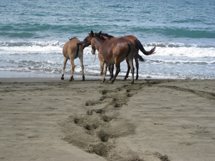
Concession property is more commonly known as beachfront property. In Costa Rica, 95% of beachfront property is considered concession property and is governed by the Maritime Zone Law and other specific regulations including but not limited to special dispositions stated by municipalities and the ICT (Costa Rican Institute of Tourism). These legal dispositions set forth the conditions under which foreigners and local residents can own concession property. A concession in Costa Rica is defined as the right to use and enjoy a specific property located on the maritime zone for a pre-determined period of time. The state, through its respective municipality, grants this right. Note that the first 200 meters measured horizontally from the high tide line defines the boundary of the maritime zone. This zone also includes islands, pinnacles of rock, mangroves, estuaries, small islands and any small natural formation that overcome the level of the ocean. This 200 meter zone is divided into two areas:
1. Public Area: The first 50 meters measured horizontally from the high tide line. This zone is not available for ownership of any kind. No kind of development is allowed except for constructions approved by governmental entities. Further, this area is deemed a public area and any individual wishing to utilize this area for enjoyment has the right to do so. In other words, there are no truly private beaches in the Maritime Zone.
2. Restricted/Concession Area: The next 150 meters. This area is available for Concessions to be granted. A concession is in essence a “lease” on the property granted to the lessee for a specific period of time. Normally the concession period is granted for 20 years. An owner of a concession may build on that concession, subdivide the concession and perform other acts to the property. However, appropriate permits from the local municipality must be obtained.
3. Ownership Limitations: Unlike fee simple property, foreigners do not have the same rights as citizens when it comes to purchasing concession property. The law establishes that foreigners cannot be majority owners of a concession property. A foreigner can, however, enter into a partnership with a Costa Rican citizen where the ownership is divided 49% / 51% between the foreigner and Costa Rican respectively. One exception is if a foreigner has resided in Costa Rica for at least five years, then they may be majority owners of a concession. Both foreigners and Costa Ricans alike are required to purchase all Maritime Zone property through concession.
Properties in Condominium:
When US citizens think of Condominiums, they normally think of large apartments or townhouses. In Costa Rica, however, there is a specific law called “Condominium Law” that provides certain benefits to developers of many different types of properties, including single family residence projects, finished lot projects, condos, etc. This set of laws allows a developer to restrict and regulate certain aspects of the development. Each Condominium developments has its own by-laws containing all of the restrictions, limitations and privileges that can be enjoyed by individuals who purchase a property in such a development. Ownership of property “in condominium” is fee simple ownership, but usually carries with it a few additional restrictions set forth by the developer. It is advised that you require the owner of the property to give you a copy of the by-laws to check for architectural guidelines, land use restrictions, and other limitations that may be placed on your property. Most often, developers use the condominium laws to allow them to build private roads in a development and set architectural guidelines. For the most part, condominium laws are designed to protect the integrity of a development and maintain the “look and feel” of the project.
Untitled property
... also called "possession" land. Most of the land in Costa Rica falls in this category. Even though many lands are untitled, it does not mean that they do not qualify for title. Some do and some don’t. In a possession scenario, it is the recording of the legal transaction that establishes possession or ownership rights...not a title. The reason for this is that for many years, farmers and settlers (for any number of reasons) never applied for their title but possessed them in a "legal manner", established boundaries and transferred rights through private documentation. When properly recorded, these rights are completely legal, fully transferable and can qualify for inscription in the national registry as fee simple title. Legitimate possession rights can be demonstrated by researching the history of ownership recorded through private documentation. This is done through a properly recorded bill of sale in a lawyer’s protocol book. The bill of sale or carta de venta shows transfer of ownership and describes the property in words relating to the surrounding properties and well defined landmarks. Pages from the lawyer’s protocol book are then registered in the national registry.
The other side of the possession issue, are lands occupied and claimed by illegitimate settlers or "squatters"; someone claiming rights of ownership but have no "ownership documentation", only that they occupied the land for a certain amount of time. In these cases, there may be some form of rights established but it is more difficult to define. Costa Rica does have a homestead law or precario law that sets the guidelines, however it is outdated and needs to be modified. Sometimes there is a clear distinction between "legitimate possession" and "illegitimate possession" and sometimes there is not!
In 1941, a titling procedure called Ley de Informacion Posesoria was created by the government as a means for landholders to record or "register" their land that has been "held in possession". Many lands have been registered using this procedure. Minimum requirements to qualify for a registered title to possession land are a registered survey and verifiable history of legitimate possession "passively and publicly" for a minimum of 10 years with no disputes. The remaining parts to complete the title process are notarized statements from adjacent property owners along with a judge’s inspection and review of all documents. This process, done with the help of a lawyer, can take up to a year (possibly more) and cost between $1,500 and $3,000 depending on the size of the land. NOTE: Possession lands cannot be liened or mortgaged as they have not yet been recorded in the national registry.
In some cases, a buyer will pay for the title process after the sale or even make it a condition of the sale or escrow. Keep in mind that not all cases are alike. It takes a good understanding of the history of ownership for each property. In general terms, it is a good rule to not buy untitled property if you are not clear about how it works. However, considering that most of the land in the country is untitled, it is logical that most of the land transactions have to do with untitled land. Many people have safely bought possession lands including foreigners.
Time Share:
This option allows an owner the right to use a property for certain weeks of the year. In most cases the time-share ownership grants similar rights as implied in the condominium regulation except that in the time-share it is limited to certain weeks during the year. In this manner one single unit is subdivided into parts and sold individually. Time-share resorts are not common in Costa Rica.


 Posts
Posts